









Introduction
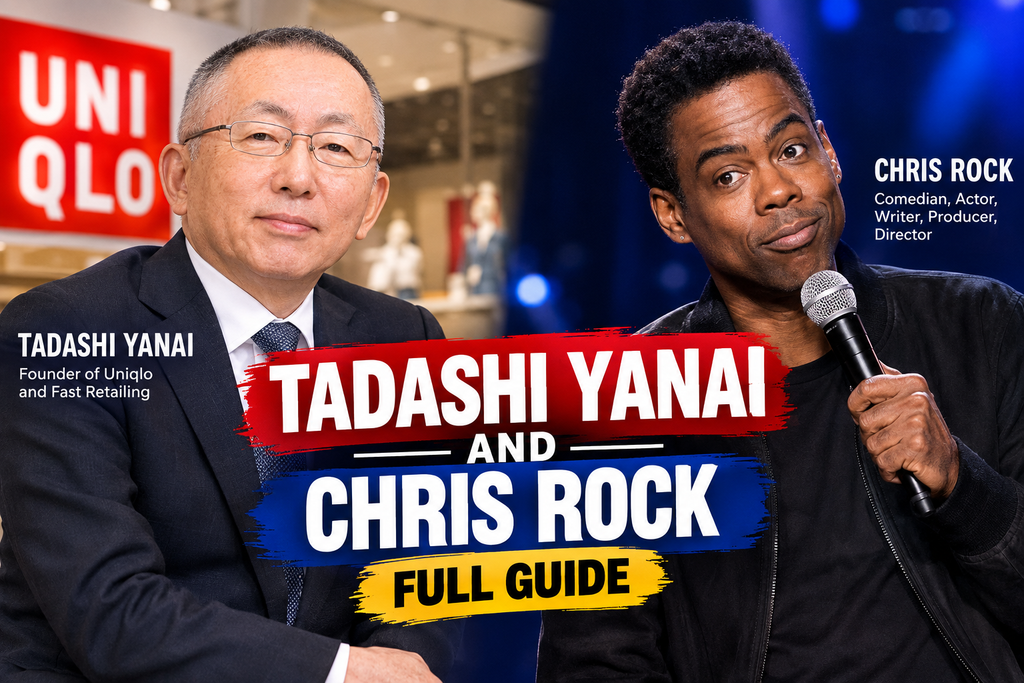
Tadashi Yanai and Chris Rock come from remarkably different worlds, yet their careers offer an intriguing study in how individual vision can develop into international influence. Yanai built his reputation through retail, business strategy, and the global expansion of UNIQLO, while Rock became known through stand-up comedy before expanding into television, film, writing, producing, and directing. Interestingly, both men were born on February 7—Yanai in 1949 and Rock in 1965. Beyond that coincidence, there is no widely documented major professional or personal relationship connecting them. (Fast Retailing)
The appeal of comparing these two figures therefore lies less in a shared project and more in what their contrasting careers reveal about modern success: one built a worldwide consumer brand, while the other built a recognizable creative voice.
Two Figures, Two Professional Worlds
| Figure | Known for | Field | Notable path |
|---|---|---|---|
| Tadashi Yanai | Building Fast Retailing and UNIQLO | Retail and business | Family retail business → global apparel company |
| Chris Rock | Comedy, acting, writing and filmmaking | Entertainment | Stand-up → television → film → directing |
Tadashi Yanai joined his family’s retail business in 1972 and eventually became its central architect. Under his leadership, the company moved toward casual clothing and developed UNIQLO into an international brand. Fast Retailing’s official biography records his appointment as president and CEO in 1984 and his continuing leadership roles within the group. (Fast Retailing)
Chris Rock followed a completely different route. His early work in stand-up eventually led to television and film opportunities, including his influential period on Saturday Night Live. He later became an actor, producer, writer, director, and creator of Everybody Hates Chris. The Television Academy credits him with four Emmy Awards and three Grammy Awards. (Television Academy)
Tadashi Yanai and the Making of a Global Retail Philosophy
Yanai’s significance extends beyond the size of the company he helped build. His approach has centered on making everyday clothing functional, accessible, and adaptable rather than treating fashion solely as a cycle of short-lived trends.
UNIQLO’s LifeWear philosophy reflects that approach. Fast Retailing describes the broader mission as using clothing to improve people’s lives while pursuing continuous improvement. (Uniqlo Images)
Moreover, Yanai’s own career contains an important human element: experimentation has sometimes involved failure. His business history demonstrates that large-scale success does not necessarily emerge from a single perfect decision. Instead, it can develop through repeated adjustments, changing strategies, and learning from markets.
That philosophy is particularly visible in the company’s international development. The first UNIQLO store opened in Hiroshima in 1984, while the brand subsequently developed a much larger international presence. (HKEX News)
Chris Rock and the Evolution of a Comedic Voice
Chris Rock’s career has similarly involved continual reinvention, although his tools have been words, performance, storytelling, and filmmaking rather than retail systems.
His stand-up became known for observational comedy that frequently examined race, relationships, culture, wealth, and social expectations. However, his career did not remain confined to the comedy stage. He moved into acting, television production, screenwriting, directing, and film. His work on Everybody Hates Chris transformed autobiographical experiences into a television story with a broader cultural audience. (Television Academy)
In 2026, that willingness to evolve remains visible. Rock wrote, directed, and stars in Misty Green, which premiered at the Toronto International Film Festival in September. The film focuses on an actress attempting to revive her Hollywood career and uses the entertainment industry itself as part of its cultural setting. (People.com)
A Shared Birthday, but Not a Shared Career
The February 7 connection is unusual enough to attract attention, but it should not be confused with evidence of a deeper relationship.
Yanai was born in Japan in 1949, while Rock was born in South Carolina in 1965 and grew up in Brooklyn. Their professional environments, cultural backgrounds, and career trajectories developed along very different lines. (Fast Retailing)
Still, the coincidence provides an interesting editorial starting point. Two people born on the same calendar date eventually became highly recognizable in completely different global industries. One became associated with clothing and corporate expansion; the other with comedy and cinematic storytelling.
What Their Careers Have in Common
Although the industries are unrelated, several broad themes connect their professional stories.
First, both developed distinctive identities. Yanai’s business became closely associated with UNIQLO’s functional approach and LifeWear concept. Rock became associated with a particular comedic perspective and a willingness to move between performance and filmmaking.
Second, both expanded beyond their original professional roles. Yanai’s work extends into philanthropy and social initiatives, while Rock has repeatedly moved between stand-up, television, acting, writing, and directing. Fast Retailing also documents Yanai’s involvement with the Fast Retailing Foundation. (Fast Retailing)
Finally, both demonstrate the importance of adaptation. Retail markets change, audiences change, and creative industries change. Consequently, longevity often requires a willingness to move beyond the role that first created recognition.
Why the Comparison Is Interesting in 2026
The comparison becomes particularly timely because both figures remain connected to active professional work.
Yanai continues to lead Fast Retailing, with the company pursuing further international growth and a broader global retail strategy. Bloomberg reported in late 2025 that Fast Retailing had generated substantial international revenue and that Yanai was pursuing ambitious future expansion. (Bloomberg)
Meanwhile, Rock’s 2026 work illustrates another form of reinvention. Misty Green places him behind the camera as well as in front of it. At TIFF, Rock discussed his desire not to repeat the same creative role indefinitely and described the project as an opportunity to explore drama and Hollywood from another angle. (CityNews Toronto)
That makes their stories relevant beyond celebrity or business biography. Both demonstrate how established public figures can continue experimenting after achieving recognition.
Influence Beyond the Original Job
One of the more revealing aspects of their careers is how their influence extends beyond their official job descriptions.
Yanai’s influence can be seen in the way UNIQLO positioned everyday clothing as a combination of functionality, design, and technological innovation. The company has also used partnerships and social initiatives to connect clothing with wider cultural and humanitarian themes. (Uniqlo Images)
Rock’s influence works differently. His impact comes through cultural commentary, comedy, storytelling, and the ability to turn everyday social observations into entertainment. His latest directorial work continues that tradition by examining Hollywood itself as a complicated social environment. (CityNews Toronto)
Thus, their influence is not identical, but neither is it limited to a job title.
The Human Side of Reinvention
Perhaps the most useful lesson from comparing Tadashi Yanai and Chris Rock is the human story underneath professional success.
A retail entrepreneur must understand customers, products, markets, and organizational systems. A comedian and filmmaker must understand audiences, characters, timing, and cultural tension. Nevertheless, both careers require curiosity about people.
Yanai’s LifeWear philosophy is ultimately built around everyday human needs: what people wear, how clothing functions, and how products can fit into ordinary life. Rock’s storytelling similarly begins with human behavior, though his medium is humor and narrative rather than clothing. (Uniqlo Images)
In that sense, their careers meet at an unexpected point: both have built professional identities around observing how people live.
Conclusion
Tadashi Yanai and Chris Rock are not linked by a famous collaboration, shared company, or documented personal partnership. Their most obvious connection is the February 7 birthday they share, separated by 16 years and two very different cultural backgrounds. (Fast Retailing)
Yet the comparison remains meaningful because their careers illustrate two distinct forms of international influence. Yanai transformed a family retail business into the global UNIQLO enterprise, while Rock developed from a stand-up comedian into a multifaceted entertainer and filmmaker.
Ultimately, the stories of Tadashi Yanai and Chris Rock suggest that long careers are rarely static. Whether the medium is clothing, comedy, television, or film, lasting relevance can come from continuing to adapt, experiment, and develop a recognizable point of view.
I kept the keyword within the requested limit and avoided inventing a connection between the two figures.